

Hans Binder adds agitator dryers to its product portfolio
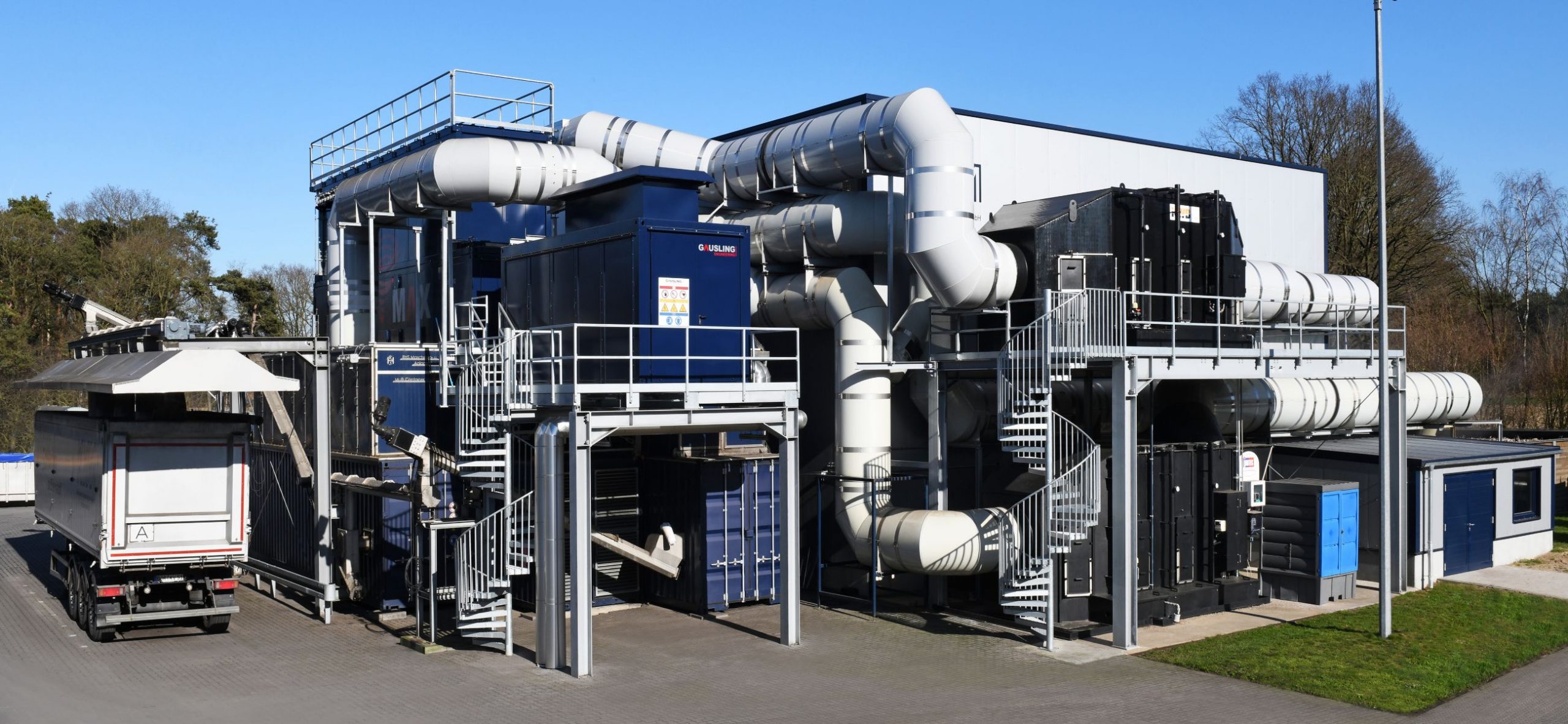
Hans Binder is expanding its portfolio in the field of industrial drying technology: In addition to its proven belt dryers, agitator dryers are now also part of the product range. This means that customers can now choose between two complementary drying solutions that can be precisely matched to different products, moisture contents and throughput volumes.
Especially for sewage sludge, industrial sludges, liquid digestate and other materials with a high moisture content, the agitator dryer offers an economical and reliable alternative.
This expansion is a logical step: Drying tasks are becoming increasingly individual. Municipal wastewater treatment plants, biogas plants and industrial companies face very different requirements – ranging from highly fluctuating material properties and limited installation space to annual volumes that do not economically justify the use of a large belt drying system. This is exactly where the agitator dryer demonstrates its strengths.
Table of contents
- The agitator dryer: Drying technology for high-moisture materials
- Efficient drying for demanding materials
- Drying solution for sewage sludge, industrial sludge and liquid digestate
- Ideal for small to medium throughput volumes
- The advantages of the agitator dryer at a glance
- Belt dryer or agitator dryer?
- Which drying solution is right for your product?
- Frequently Asked Questions about Agitated Dryers
The agitator dryer: Drying technology for high-moisture materials
An agitator dryer works according to a simple yet highly effective principle: The wet product is continuously moved by a rotating agitator inside a closed drying chamber while heated process air is simultaneously passed over the material.
The combination of convection and continuous product movement repeatedly exposes fresh, moist surfaces. This constant mixing creates a very large evaporation surface. As a result, water can be transferred quickly and evenly to the process air – one of the main reasons for the high energy efficiency of this drying technology.
At the same time, the continuous movement prevents lumps and deposits from forming. The material is not only dried, but is kept in a defined, homogeneous structure throughout the entire process.
Compact and closed design
Another advantage is the compact, closed design. In relation to their performance, agitator dryers require comparatively little installation space and can therefore also be integrated into existing plant concepts where space is limited.
The closed process design also supports the controlled removal and treatment of the resulting vapors.
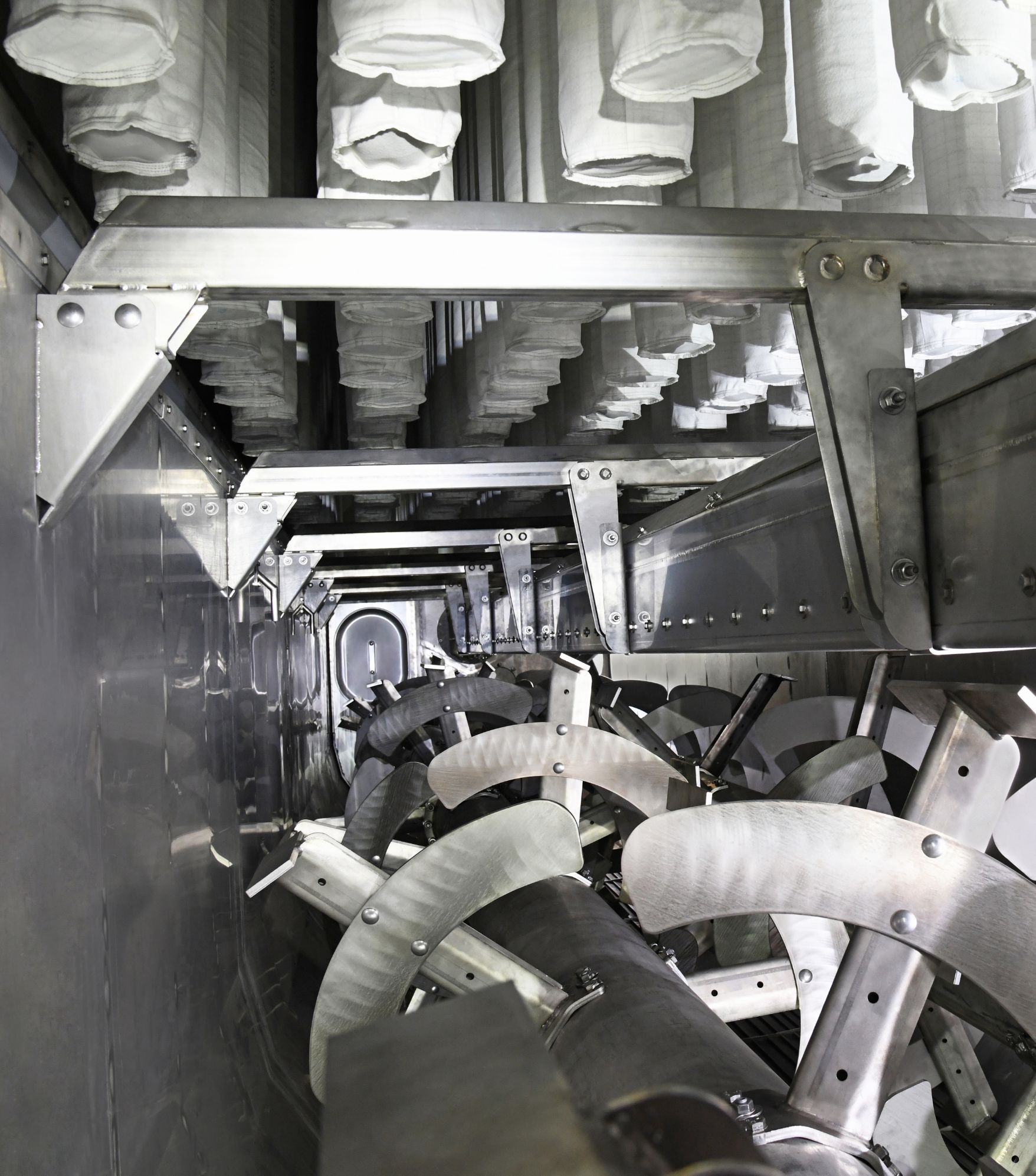
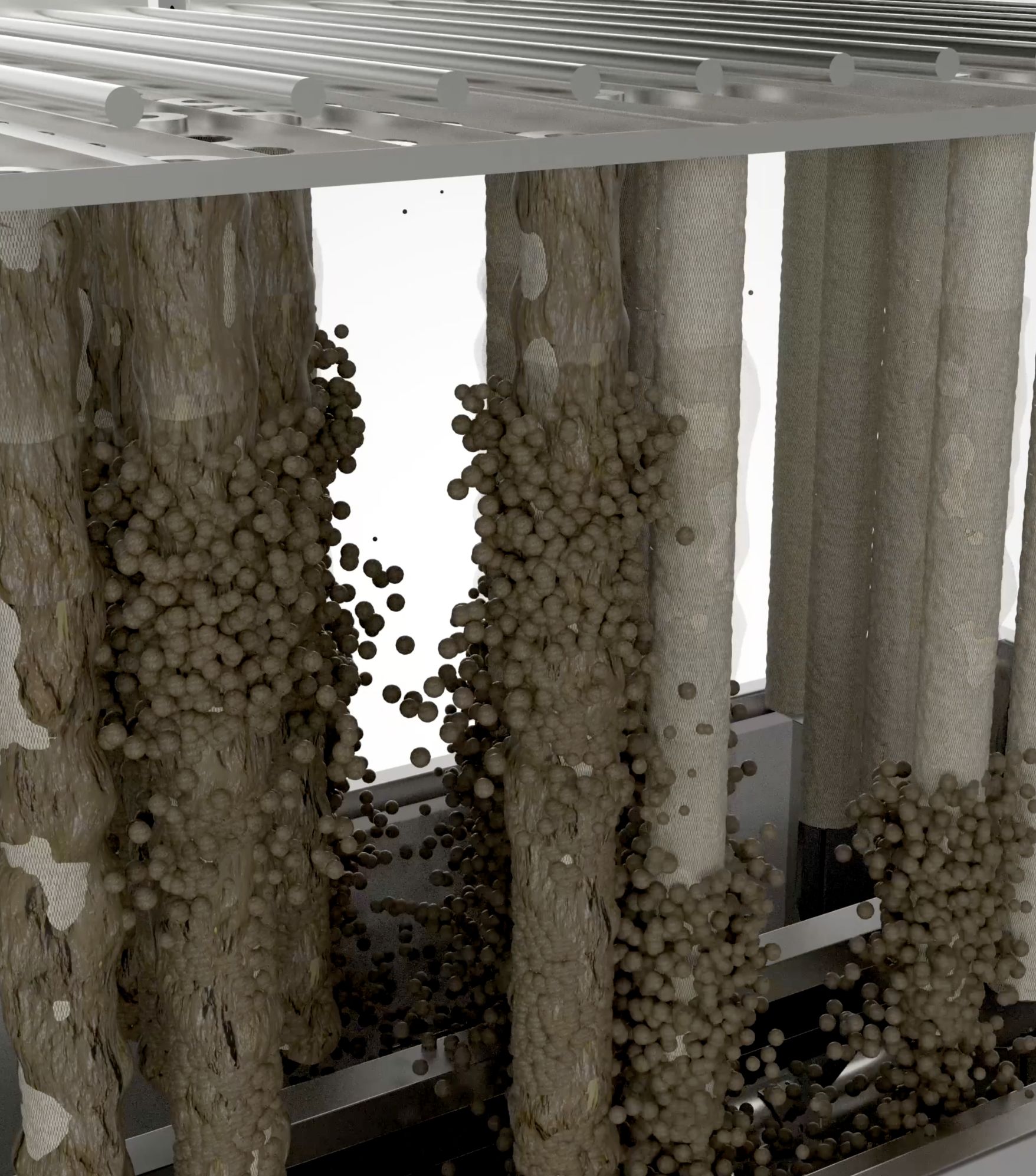
A look inside: The agitator continuously moves the product, while integrated filter elements keep dust within the process.
Efficient drying for demanding materials
Not every material behaves in the same way during drying. Materials with a high moisture content tend to change their physical properties significantly during the drying process: A pumpable, almost liquid mass first becomes a viscous, sticky material before eventually turning into a crumbly, free-flowing product.
This transition is the critical phase in many drying processes. The agitator dryer is specifically designed to handle this situation.
Reliable processing even during sticky phases
Continuous mechanical treatment ensures that the product continues to be reliably conveyed and mixed even when it becomes particularly sticky. Deposits on walls and internal components are reduced, bridging is prevented and the process remains stable – even when material properties change.
This makes the technology particularly interesting for operators whose feed material varies seasonally or from batch to batch. Instead of having to completely readjust the process after every change, operation remains within a robust process window.
Drying is gentle and uniform, which is crucial for the quality and further usability of the dried product.
Drying solution for sewage sludge, industrial sludge and liquid digestate
Typical applications for agitator dryers are found wherever high moisture contents and difficult material properties occur together.
Drying solution for sewage sludge
In sewage sludge drying, the so-called sticky phase presents a particular challenge. During this stage of drying, the sludge becomes highly viscous and extremely sticky. It tends to adhere to surfaces and block the material flow.
The agitator mechanically breaks through this condition: The product is continuously divided and mixed so that the sticky phase can be passed through in a controlled manner without the process coming to a standstill.
For municipal wastewater treatment plants that want to reduce the volume and weight of their sludge before further utilization, this is a key advantage.
Alternatively, you can also find further information about our belt drying system in Slovenia, which was recently commissioned.
Drying solution for industrial sludges
Industrial sludges from production processes or wastewater treatment can also be reliably processed using agitator dryers. The technology is comparatively insensitive to inhomogeneities and remains stable even when dry matter contents fluctuate significantly.
Drying solution for liquid digestate
Biogas plants generate digestate with a very high water content. Storage and spreading are logistically demanding and increasingly regulated.
Drying significantly reduces volume and weight. The material becomes easier to store and transport and can be reused as fertilizer or as a valuable material.
The agitator dryer offers an economical solution here, especially because it can also handle feed material with a very high moisture content.
In addition, the technology is generally suitable for all materials with a high moisture content that require gentle treatment and uniform mixing.
Ideal for small to medium throughput volumes
Agitator dryers demonstrate their strengths particularly at annual capacities of up to approximately 10,000 to 12,000 tonnes. In this range, they offer a highly attractive combination of investment costs, operating costs and process reliability.
For many operators, this is exactly the decisive range: The amount of material is too large to dispose of untreated or process entirely externally – but too small to operate a large-scale drying system economically.
Decentralized drying directly at the point of origin
The agitator dryer closes this gap. It enables decentralized drying directly at the point where the material is generated, shortens transport routes and makes operators less dependent on external disposal capacities and their price development.
Another advantage is the relatively small space requirement. Where an expansion of an existing plant might otherwise fail due to spatial limitations, an agitator dryer can often still be integrated effectively.
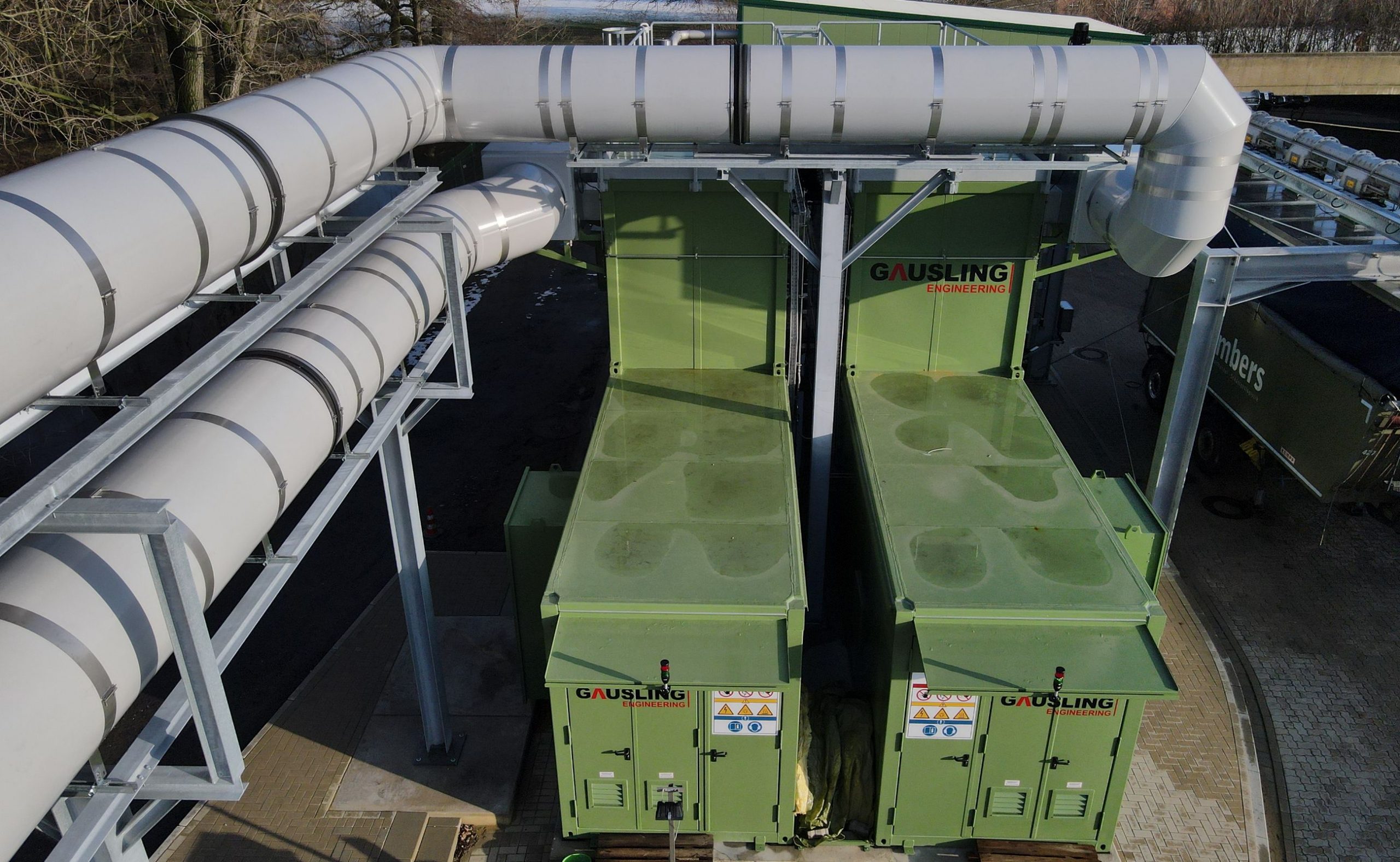
Agitator dryer in practice: Compact design with connected process air and vapor handling.
The advantages of the agitator dryer at a glance
- Expansion of the Hans Binder product portfolio with another proven drying technology
- Ideal for sewage sludge, industrial sludges, digestate and high-moisture materials
- Economical solution for small to medium throughput volumes of up to approximately 10,000 to 12,000 tonnes per year
- Gentle and uniform drying through continuous product movement
- High energy efficiency due to a large evaporation surface
- Reliable processes even with changing material properties
- Safe passage through the sticky phase without lump formation or deposits
- Compact, closed design with low space requirements
Belt dryer or agitator dryer?
Every drying material places different demands on the process. Three factors are particularly important: the product itself, its moisture content and the planned throughput.
Belt dryers for high throughput volumes
Belt dryers are the first choice when large quantities need to be dried at low temperatures and with high energy efficiency, and when the material can be evenly distributed as a bulk layer.
They have formed the basis of the Hans Binder product portfolio for decades and are used worldwide.
Agitator dryers for high-moisture and sticky materials
Agitator dryers complement this range wherever small to medium quantities are involved, the material is particularly wet or sticky, or continuous mechanical movement of the product is required.
With the expansion of its portfolio, Hans Binder can now advise customers even more precisely. Instead of forcing an application into an existing process, the drying technology is individually matched to the specific task.
In some cases, a combination of both technologies may also be the most economical solution.
Which drying solution is right for your product?
Whether sewage sludge, industrial sludge, digestate or another high-moisture material: Our experts analyze your application and work with you to develop the right drying solution.
Further information about agitator dryers can be found here.
Alternatively, you can find more information about our product range in our overview of drying solutions.
If you have any further questions, please feel free to contact us at any time:
Phone: +49 (0) 8631 187 557-0
E-Mail: info@hb-dryer.com

Frequently Asked Questions about Agitated Dryers
An agitator dryer is a convective dryer in which the wet product is continuously moved by a rotating agitator inside a closed chamber. At the same time, heated process air flows over the material. Continuous mixing creates a large evaporation surface, allowing moisture to be removed quickly and evenly.
The technology is particularly suitable for sewage sludge, industrial sludges, liquid digestate and other materials with a high moisture content. Products with strongly fluctuating properties can also be processed reliably.
Agitator dryers are particularly economical for small to medium annual capacities of up to approximately 10,000 to 12,000 tonnes. For larger volumes, a belt dryer is generally the more suitable drying solution.
The sticky phase is the stage of drying during which sewage sludge becomes particularly adhesive. The agitator continuously breaks up and mechanically moves the material. This allows the sticky phase to be passed through in a controlled manner, prevents lump formation and deposits, and keeps the process stable.
This depends on the product, its moisture content and the throughput. Belt dryers are suitable for large quantities and materials that can be evenly distributed, while agitator dryers are ideal for small to medium quantities as well as particularly wet or sticky products. Hans Binder offers both technologies and provides individual advice on which solution is the most economical for each specific application.

