

Innovation in Mechanical Engineering: How Hans Binder Develops Energy-Efficient Drying Technologies Through the R&D Tax Incentive
Tax incentives for research as a driver of innovation in special-purpose machinery – a practical example from Hans Binder Engineering GmbH
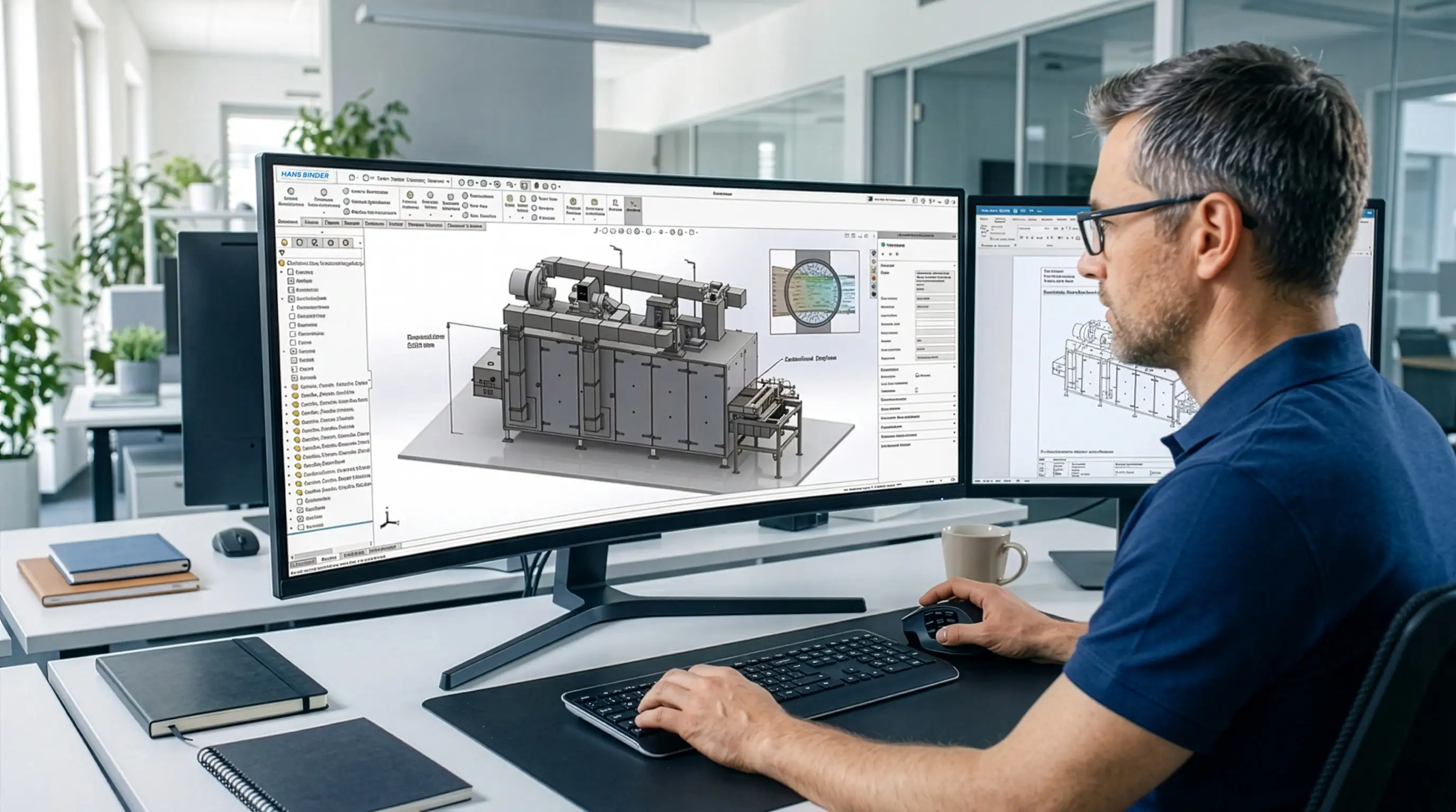
Table of Contents
What Is the R&D Tax Incentive?
The R&D Tax Incentive is a tax-based funding scheme for companies carrying out research and development projects. It supports innovation regardless of industry or company size and significantly reduces the actual costs of development.
Companies in mechanical and plant engineering benefit in particular, as development projects often meet the legal eligibility requirements. Eligible activities include the development of new machine concepts, prototypes, process innovations, as well as technologies for energy savings and digitalization.
In Brief
✔ Funding for research and development
✔ Available to small, medium-sized and large companies
✔ Tax relief instead of a traditional grant
✔ Legal entitlement if the eligibility requirements are met
✔ Also attractive for medium-sized mechanical engineering companies
Good to know: Since 2026, the framework conditions for the R&D Tax Incentive have been further improved. As a result, companies can claim higher eligible costs, making the incentive even more attractive, especially for small and medium-sized enterprises.
Research and Development Are Part of Hans Binder’s DNA
For decades, Hans Binder Engineering GmbH has been developing customized industrial drying systems for a wide range of applications. Unlike standardized series-produced machines, virtually every system is designed as a tailor-made solution to meet the specific requirements of each individual customer.
Applications range from sludge drying, food, pet food, wood, biomass, and recycling to numerous specialized industrial applications.
This diversity makes continuous research and development essential. Different product characteristics, increasing demands for energy efficiency, and individual customer processes require innovative solutions that are precisely tailored to each specific application.
For Hans Binder, research is therefore not limited to fundamental scientific work. Instead, it primarily means the continuous improvement of existing technologies and the development of new processes that provide customers with real economic value.
The Goal of Every Development
- Reduced energy consumption
- Höhere Wirtschaftlichkeit
- Maximum process reliability
- Customized solutions for complex products
- Sustainable and resource-efficient production processes
This continuous commitment to innovation is one of the reasons why companies around the world rely on Hans Binder’s individually developed drying technologies. Every new development helps make industrial drying processes even more efficient, economical, and sustainable.
Practical Example: A New Generation of Energy-Efficient Drying Technology
A current development project clearly demonstrates the importance of research and innovation at Hans Binder. The company is currently developing a new generation of energy-efficient drying technologies designed to significantly reduce the energy consumption of industrial drying processes.
For this project, Hans Binder is investing a six-figure amount in research and development. The goal is to develop an innovative prototype that sets new standards in terms of energy efficiency, economic performance, and sustainability.
Managing Director Hans-Xaver Hiermeier describes the importance of the R&D Tax Incentive as follows:
“Without the R&D Tax Incentive, a project like this would not be financially feasible for us.”
This statement highlights how important tax-based R&D funding is, particularly for medium-sized companies. Development projects in special-purpose machinery are often associated with significant investments and technical risks. New processes must be developed, tested, and continuously optimized before they are ready for the market.
The R&D Tax Incentive provides an important financial framework and supports companies in transforming innovative ideas into market-ready technologies.
Further insights into this practical example can be found in the specialist article published by Creditreform München.

Why Research and Development Are Crucial in Mechanical Engineering
Mechanical and plant engineering is one of Germany’s most innovation-driven industries. Today, companies face the challenge of continuously making production processes more efficient, sustainable, and cost-effective. At the same time, requirements regarding energy consumption, automation, and resource efficiency continue to increase.
Especially in special-purpose machinery, new technical solutions are constantly being developed to meet the individual requirements of each customer. Unlike series-produced products, there is often no standard solution—every system must be rethought, designed, and tested from scratch.
This development work involves significant efforts in engineering, calculation, simulation, prototype construction, and practical testing. This is exactly where the R&D Tax Incentive comes in, helping companies turn innovative developments into economically viable solutions.
Research and Development (R&D) Explained Simply
Research and development (R&D) refers to the systematic development of new products, processes, or technologies. The objective is to generate new technical knowledge or significantly improve existing solutions. In particular, projects that explore new technological territory and whose outcome is uncertain at the outset are eligible for funding.
Which Projects Can Be Funded Through the R&D Tax Incentive?
Many companies assume that only universities or large corporations are eligible for R&D funding. In reality, however, many development projects carried out by small and medium-sized enterprises can also qualify for funding—particularly in mechanical and plant engineering.
Typical examples include:
- Development of new machines and systems
- Optimization of existing production processes
- Development of energy-efficient technologies
- Automation and digitalization solutions
- New control and regulation concepts
- Prototype development
- Pilot and test facilities
- Experimental development projects
Companies such as Hans Binder, which develop customized drying systems and continuously work on new technical solutions, often meet the requirements for tax-based R&D funding.
Examples of Eligible Development Projects
| Entwicklung eines Prototyps | ✔ Ja |
|---|---|
| Entwicklung eines Prototyps | ✔ Ja |
| New energy-efficient belt dryer | ✔ Yes |
| Prototype development | ✔ Ja |
| Automation of an existing system | ✔ Often yes |
| Standard series production | ✖ No |
| Maintenance of existing systems | ✖ No |
More Than Financial Support – A Competitive Advantage for Innovative Companies
The R&D Tax Incentive offers companies more than just tax relief. Above all, it provides planning security for long-term innovation projects and facilitates investments in new technologies. Small and medium-sized enterprises, in particular, can realize developments that would otherwise be significantly more difficult to implement from an economic perspective.
For Hans Binder, this means continuously advancing innovative technologies and providing customers with even more efficient solutions in the long term. The main focus areas include:
- Increasing energy efficiency
- Optimizing thermal processes
- Reducing operating costs
- Improving process reliability
- Sustainable use of available energy
- Resource-efficient production processes
These aspects are becoming increasingly important, especially in energy-intensive industries. Today, companies invest not only in more powerful machinery but also in intelligent technologies that permanently reduce energy consumption and operating costs.
Why Careful Preparation Is Essential
As attractive as the R&D Tax Incentive is, a successful application requires careful planning and thorough documentation. Development objectives, the degree of innovation, the project scope, and the time invested by the employees involved must all be clearly documented.
Hans Binder’s practical example shows that comprehensive documentation can be particularly challenging. Working with specialized consultants helped prepare the application efficiently and avoid common mistakes.
Key Success Factors for Approval
- Clearly defined project objectives
- Demonstrable degree of innovation
- Comprehensive documentation of all development activities
- Realistic planning of time and costs
- Technical description of the development objective
- Complete recording of project hours
Early planning not only simplifies the funding application but also creates a well-structured foundation for the entire development project.
Our Tip
Companies that regularly develop innovative machinery or processes should assess at an early stage whether their projects may qualify for the R&D Tax Incentive. This allows the necessary documentation to be integrated into the development process from the very beginning, avoiding additional work later on.

Frequently Asked Questions About the R&D Tax Incentive in Mechanical Engineering
The R&D Tax Incentive is a tax-based funding program provided by the German federal government to support companies carrying out research and development projects. Its purpose is to promote innovation in Germany and help businesses develop new technologies, products, and processes in an economically viable way. Instead of a traditional grant, the funding is provided through tax relief, which can significantly reduce the actual costs of development.
In principle, companies of any size and from almost any industry can apply for the R&D Tax Incentive—from small family-owned businesses to internationally operating industrial companies. The decisive factor is not the size of the company, but whether the development project meets the legal eligibility requirements.
Yes. Mechanical and plant engineering companies frequently develop customized solutions, prototypes, and innovative processes that may qualify for funding. The practical example of Hans Binder Engineering GmbH demonstrates how the R&D Tax Incentive can help medium-sized companies implement innovative technologies in an economically viable way.
Depending on the project, eligible costs may include personnel expenses, in-house development work, contract research, and other costs defined by law. Which expenses are actually eligible depends on the applicable legal regulations.
Yes. The development and testing of prototypes are among the typical research and development activities that can be taken into account under the R&D Tax Incentive, provided the legal eligibility requirements are met.
Ideally, planning should begin as soon as the development project starts. Early documentation of all relevant activities significantly simplifies the application process and helps ensure that all important information can later be fully documented and verified.
Why innovation means far more to Hans Binder than just new machines
Innovation does not begin with an entirely new machine. In many cases, it is the numerous technical optimizations in the details that create the greatest value for customers. Improved airflow systems, more efficient heat recovery, intelligent control systems, and optimized process sequences can significantly reduce energy consumption while increasing the economic efficiency of a drying system.
This is precisely the approach Hans Binder has been pursuing for many years. Every new development is driven by the goal of making industrial drying processes more efficient, more sustainable, and more economical. The result is customized drying system concepts that are precisely tailored to each customer’s specific requirements
Typical development goals at Hans Binder
- Increasing energy efficiency
- Reducing CO₂ emissions
- Improving heat recovery
- Optimizing thermal processes
- Increasing system availability
- Customized solutions for a wide variety of products
- Sustainable use of resources
Customized drying solutions for a wide range of industries
Hans Binder’s continuous research and development activities directly contribute to a broad range of applications. This results in tailor-made drying solutions for numerous industries and products.
Our application areas
Every industry has different requirements regarding temperature control, energy consumption, throughput capacity, and product quality. That is why Hans Binder does not develop standard solutions, but customized drying systems that are precisely tailored to each individual process.
Sources & further information
This article is based, among other sources, on the specialist article “Eligible Thanks to Good Preparation”, published by Creditreform München. In the article, Managing Director Hans-Xaver Hiermeier shares Hans Binder Engineering GmbH’s experience with Germany’s R&D Tax Incentive.
Research and development are key success factors in modern mechanical and plant engineering. The R&D Tax Incentive creates incentives to advance innovative technologies in an economically viable way and to remain competitive in the long term. The example of Hans Binder Engineering GmbH demonstrates how government funding and entrepreneurial innovation can successfully work together.

