

Efficient sawdust drying: A compact container solution for industrial wood drying
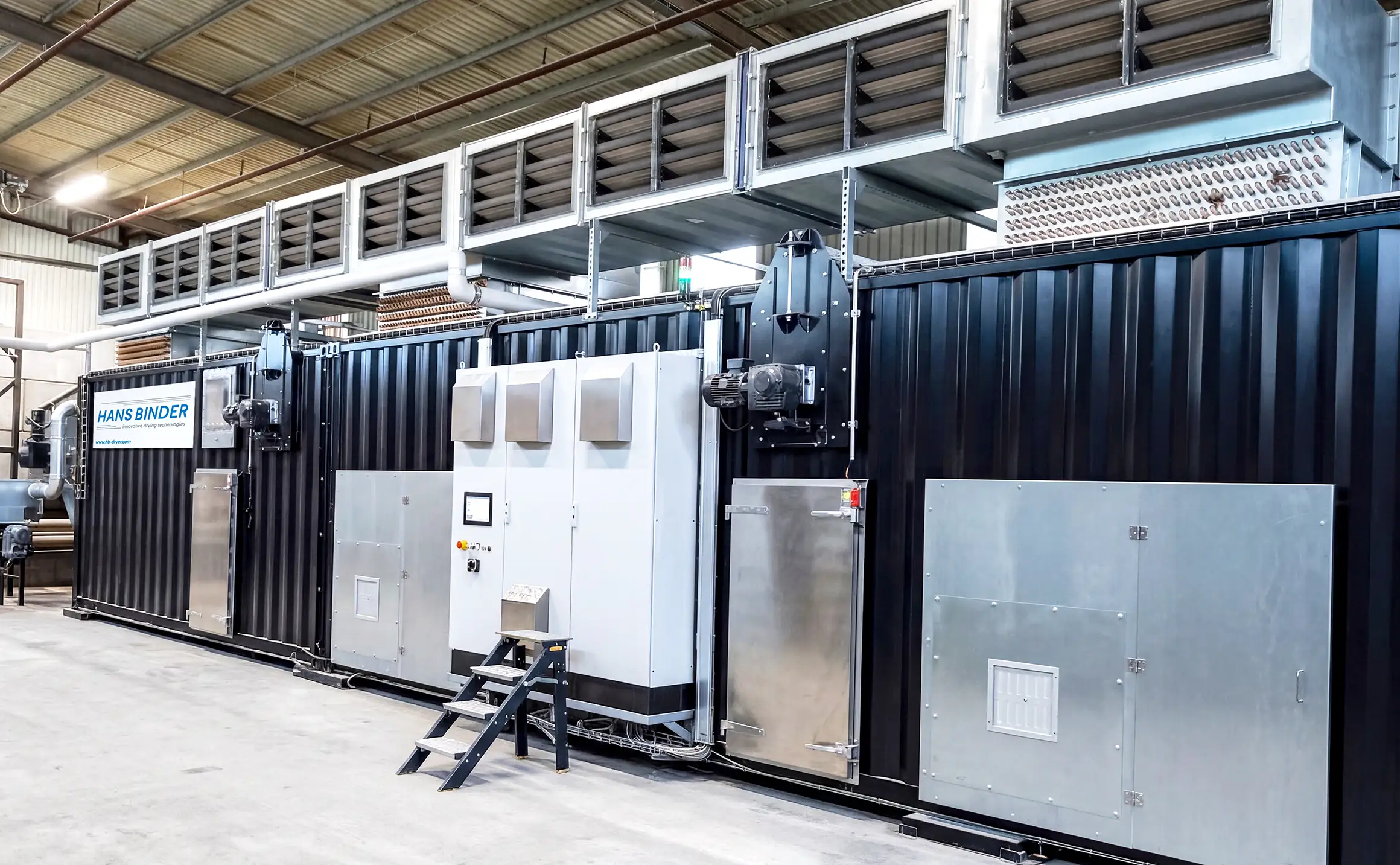
The industrial drying of sawdust presents wood processors with a number of challenges. Varying moisture contents, different material properties, and limited installation space require a drying solution that can be flexibly adapted to the respective production process.
A project in Sweden demonstrates how these requirements can be met economically with a compact container belt dryer. The solution uses the CBT-DS-E-2.0 Container Belt Dryer, enabling rapid integration, reliable continuous operation, and uniform drying of sawdust.
Table of contents
- Industrial sawdust drying
- The challenge for the wood processor
- The solution: CBT-DS-E-2.0 Container Belt Dryer
- How does sawdust drying work?
- Advantages of a containerized drying system
- Project results
- Further applications in the wood industry
- Sawdust drying FAQ
- Conclusion
Industrial sawdust drying
Large quantities of sawdust are generated in sawmills, woodworking companies, and the furniture industry. Depending on the upstream production process, the material may have a high and significantly varying moisture content. For further processing, these wood residues often need to be dried in a controlled and uniform manner.
Dried sawdust can be used for the production of wood pellets, wood briquettes, particleboard, and other wood-based products. A defined moisture content is also essential for the energy recovery of wood residues, as it influences storage stability, calorific value, and the economic efficiency of further processing.
Why is uniform drying so important?
Non-uniform drying can result in some areas of the material remaining too wet while others become overdried. This negatively affects product quality and may lead to disruptions in downstream processes. Controlled airflow and uniform material distribution are therefore essential prerequisites for a stable drying process.
The challenge: Flexible wood drying for varying material properties
A wood processing company in Sweden required a compact and flexible solution for the industrial drying of sawdust. The new drying system had to be integrated into the existing production environment without extensive structural modifications while ensuring economical continuous operation.
One particular challenge was the varying properties of the incoming material. Both the moisture content and the composition and bulk density of the sawdust can change during ongoing production. The drying system therefore had to respond flexibly to fluctuating raw material characteristics.
Key project requirements at a glance
- Uniform drying despite varying material properties
- Easy integration into the existing production environment
- Fast installation without extensive construction work
- Compact, space-saving system design
- Energy-efficient and economical operation
- Reliable technology for continuous use
Existing production facilities in particular can incur significant costs due to long installation times and extensive infrastructure work. A pre-configured container solution offers the advantage that key components are already combined and prepared in a compact unit.
The solution: CBT-DS-E-2.0 Container Belt Dryer
For this project, the CBT-DS-E-2.0 Container Belt Dryer was installed. The system is specifically designed for the continuous drying of wood-based products and combines robust belt dryer technology with a compact container design.
The dryer processes sawdust with varying moisture contents and achieves a throughput of up to approximately 2,700 kilograms of wet material per hour. The actual drying performance depends, among other factors, on the inlet moisture content, the required final moisture content, and the specific material properties.
Technical features of the system
- Drying of sawdust with varying moisture contents
- Throughput of up to approx. 2,700 kg/h of wet material
- Compact container design
- Uniform product distribution through a dosing system
- Robust belt dryer technology for continuous operation
- Fast integration into existing production environments
Thanks to its containerized design, the system can be installed and connected at the intended site with comparatively little effort. This reduces the required infrastructure work and shortens the time between delivery and commissioning.
How does sawdust drying work in a belt dryer?
In the belt drying process, the wet material is first evenly distributed onto the drying belt using a dosing and distribution system. A homogeneous product layer is essential to ensure that the drying air flows evenly through the material.
As the sawdust is continuously conveyed through the dryer, moisture is removed from the product in a controlled manner. Process parameters such as temperature, airflow, residence time, and bed depth can be adjusted to match the material properties and the desired final moisture content.
Gentle and continuous drying
Belt drying provides a comparatively gentle treatment of the material. Thanks to the controlled drying process, sawdust can be dried evenly without being exposed to unnecessarily high thermal stress. At the same time, the process is ideally suited for continuous operation and can therefore be seamlessly integrated into industrial production lines.
What are the advantages of a containerized drying system?
Containerized drying systems combine the key system components in a compact, pre-assembled unit. Compared to a drying system that is fully built on-site, this significantly reduces both planning effort and installation time.
A plug-and-play solution for existing production sites
Easy integration is particularly important at existing production facilities. The compact design makes it possible to add drying capacity without the need for extensive new buildings or complex plant structures.
- Short installation and commissioning times
- Reduced construction work
- Small footprint
- Flexible integration into existing production lines
- Manageable infrastructure costs
- Modular expansion of drying capacity
High flexibility for varying raw materials
The processing of wood residues is often influenced by seasonal fluctuations and varying material qualities. A flexibly adjustable drying system can respond to changing inlet moisture contents, bulk densities, and throughput rates. This ensures that the drying process remains stable and economical even when raw material characteristics vary.
Project results: Reliable and economical sawdust drying
The installation of the Container Belt Dryer has provided the Swedish production site with a compact and high-performance drying solution. The system enables uniform, product-friendly drying of sawdust and can be flexibly adapted to different wood-based products.
Thanks to its containerized design, the required installation work and infrastructure costs were significantly reduced. At the same time, the robust system design ensures reliable continuous operation within the existing production environment.
Project results at a glance
- Uniform and gentle drying
- Flexible adaptation to different wood-based products
- Reduced installation and infrastructure costs
- Fast commissioning of the drying system
- Reliable continuous operation
- Economical process management
Further applications in the wood and biomass industry
In addition to sawdust, belt dryers can generally be used for a wide variety of wood-based materials. The specific design of each drying system is always tailored to the product, its inlet moisture content, the required final moisture content, and the desired throughput.
Typical wood-based materials
- Sawdust
- Wood chips
- Wood fibers
- Biomass
- Bark and wood-based residues
- Raw materials for pellets and briquettes
The versatility of belt drying makes it particularly attractive for companies that process different wood-based materials or plan to expand their production processes in the future. With a project-specific system design, both drying performance and process parameters can be precisely adapted to the requirements of each production site.
Conclusion: Compact wood drying with maximum flexibility
The project in Sweden demonstrates how the industrial drying of sawdust can be efficiently implemented using a compact container solution. The Container Belt Dryer combines robust drying technology with uniform product distribution and flexible process control.
Short installation times, reduced infrastructure requirements, and the ability to adapt to varying material properties result in an economical solution for both existing and new production facilities.
Containerized belt drying therefore offers an attractive option for companies looking to process wood residues reliably while expanding their drying capacity with maximum flexibility.

Frequently asked questions about sawdust drying
Freshly produced sawdust often has a high moisture content. However, many downstream processing applications—such as the production of wood pellets, wood briquettes, or particleboard—require a defined residual moisture content. Controlled drying also improves the storage stability of the material and contributes to more economical further processing.
Belt drying has proven to be an effective solution for the industrial drying of sawdust. The material is evenly distributed on a conveyor belt and continuously dried using heated process air. This process enables uniform moisture reduction, continuous operation, and gentle handling of the material.
The Swedish reference project uses the CBT-DS-E-2.0 Container Belt Dryer. The system achieves a throughput of up to 2,700 kilograms of wet material per hour. The actual performance depends on factors such as the material characteristics, the inlet moisture content, and the required final moisture content.
In addition to sawdust, belt dryers can also be used for wood chips, wood fibers, biomass, and other wood-based residues, depending on the system configuration. The process parameters are individually adjusted to suit the respective material and the desired final moisture content.
The Swedish reference project uses the CBT-DS-E-2.0 Container Belt Dryer. The system achieves a throughput of up to 2,700 kilograms of wet material per hour. The actual performance depends on factors such as the material characteristics, the inlet moisture content, and the required final moisture content.
Containerized drying systems enable fast integration into existing production environments. Thanks to their compact design, installation effort and infrastructure costs can be reduced while maintaining a high degree of flexibility for future expansions or site modifications.
Modern belt dryers are designed to utilize the available heat as efficiently as possible. Optimized airflow, uniform material distribution, and precise process control help reduce energy consumption and operating costs. The actual savings potential, however, depends on the specific process conditions and the design of the drying system.

