

Belt dryer for digestate in Israel: Large-scale plant in Daya approaching commissioning
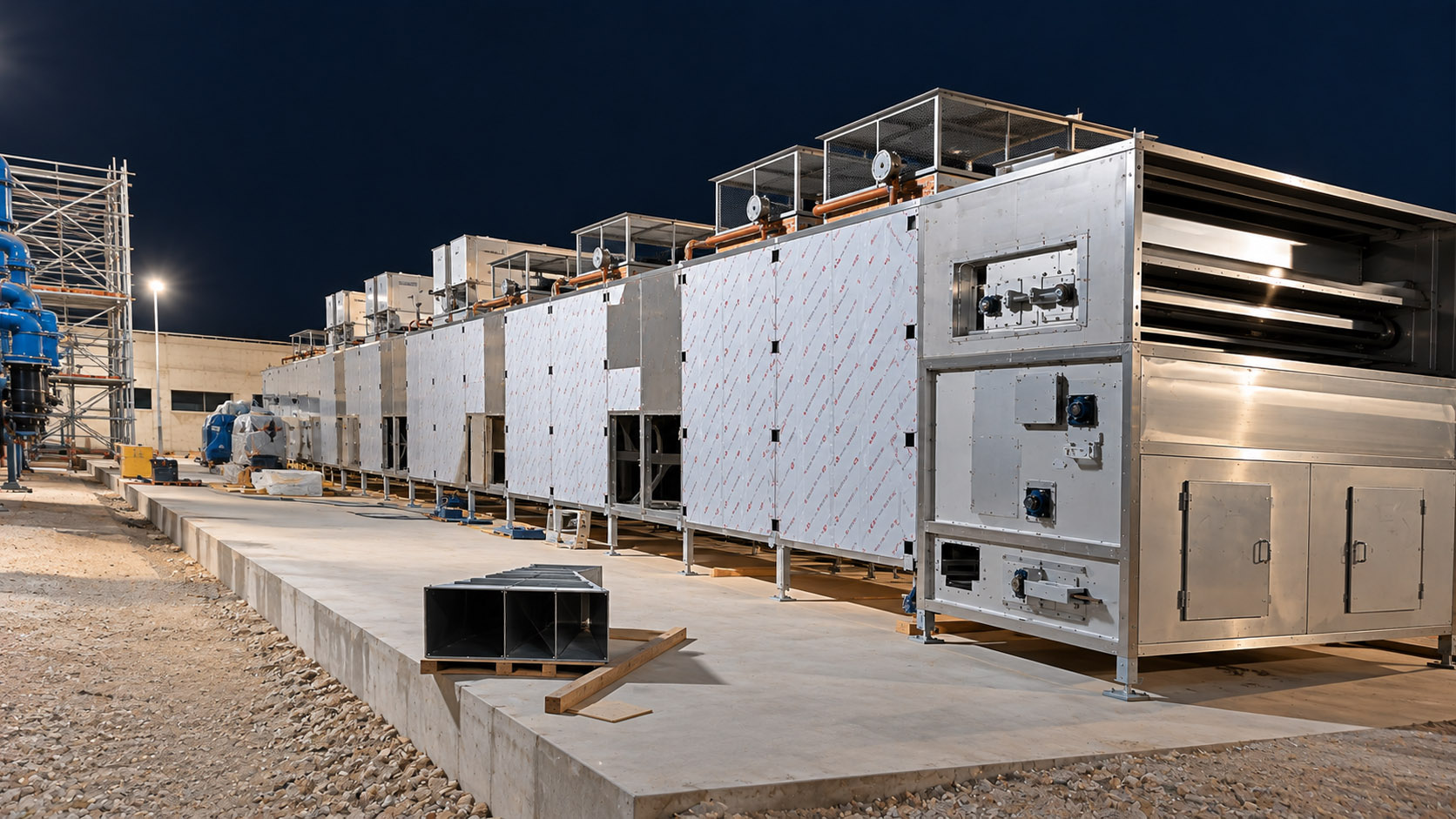
In the middle of the Negev Desert, just a few kilometers from Kibbutz Gvulot, one of Hans Binder’s most demanding drying systems of recent years is currently being built.
As part of the IL-Daya project in the Eshkol region, an approximately 50-meter-long belt drying system for digestate from the organic fraction of municipal solid waste is being implemented.
The particular challenge: The feed material has a solids content of only around 20%. Therefore, it cannot be processed directly in a belt dryer. An upstream back-mixing unit first brings the material to a consistency suitable for drying.
After around three weeks of mechanical and electrical installation on site, the system is now largely in place. The drying tunnel, back-mixing unit and parts of the peripheral equipment have already been installed. The next major step is commissioning.
Table of contents
- Drying and recovering digestate from municipal solid waste
- Why high-moisture digestate cannot be dried directly in a belt dryer
- The solution: modDryer-MRK-E-19-3 with back-mixing unit
- Technical data of the belt drying system in Israel
- Installing the belt dryer under extreme conditions in the Negev Desert
- How does digestate drying support the circular economy?
- Next step: Commissioning the drying system in Daya
- Conclusion: Belt drying of high-moisture digestate with back-mixing
Drying and recovering digestate from municipal solid waste
As part of the IL-Daya project, Hans Binder is constructing an industrial drying system together with a local partner. The Israeli partner company specializes in environmental technology and waste management.
The feed material is the organic fraction of municipal solid waste. After anaerobic digestion and processing through a screw press, a moist, nutrient-rich substrate remains.
Without further treatment, however, this material can neither be stored nor transported efficiently. The belt drying system therefore performs a crucial process step.
The liquid press-water fraction of the digestate is dried and thereby converted into a stable, storable and reusable product.
This project clearly demonstrates the role industrial drying technology can play in the circular economy. A difficult-to-handle residual material is transformed into a product that can subsequently be transported, stored and sent for further utilization.
Why high-moisture digestate cannot be dried directly in a belt dryer
The press-water fraction enters the system with a solids content of only around 20%. This makes the material too wet to be distributed evenly and directly onto the drying belt.
If fed directly into a conventional belt dryer, the material could smear across the belt. In addition, it could dry unevenly or cause the drying belt to become clogged.
The technical challenge was therefore not simply to design a suitable belt dryer. Instead, an overall process concept was required that takes the properties of the feed material into account while ensuring a stable and continuous drying process.
REQUIREMENTS FOR THE DRYING SYSTEM IN DAYA
- Reliably handle large volumes of wet press water
- Withstand the extreme climatic conditions of the Negev Desert
- Enable continuous, low-maintenance operation over many years
- Meet the requirements for emissions and operational safety
The solution: modDryer-MRK-E-19-3 with back-mixing unit
The system is based on a modDryer-MRK-E-19-3, a single-stage belt dryer with an upstream back-mixing unit.
Back-mixing is a central element of the overall system concept. Only through this process can the high-moisture feed material be prepared for subsequent belt drying.
HOW DOES BACK-MIXING WORK IN DIGESTATE DRYING?
Part of the already dried final product is continuously mixed back into the wet press water. As a result, the solids content increases. At the same time, the consistency changes sufficiently for the material to be distributed evenly onto the drying belt.
The process can be divided into three steps:
- First, the wet press water with around 20% solids content enters the back-mixing unit.
- Next, already dried material is continuously recirculated and mixed with the wet feed material.
- The prepared material is then distributed evenly onto the belt dryer and dried.
After back-mixing, the material passes through the drying tunnel. The required heat is supplied by hot-water heat exchangers.
At the end of the process, the product reaches a dry matter content of around 80%. It is therefore suitable for storage and transport and is prepared for further utilization.
Technical data of the belt drying system in Israel
The system designed for the IL-Daya project is intended for robust industrial continuous operation under the demanding climatic conditions of the Negev Desert.
SYSTEM OVERVIEW
- System type: modDryer-MRK-E-19-3
- Drying principle: Single-stage belt dryer with upstream back-mixing unit
- Installation: Outdoor belt dryer tunnel
- System length: Approx. 50 meters
- Belt area: Approx. 114 m²
- Water evaporation capacity: Approx. 2.8 tonnes per hour
- Heating: Hot-water heat exchangers with integrated heat recovery
- Control system: Fully automated Siemens S7 process control with remote maintenance module
- Material: Stainless steel design for robust continuous operation in desert conditions
- Dry matter content of the final product: Approx. 80%
The combination of back-mixing, belt drying and heat recovery enables a continuous process.
As a result, a feed material that could not be dried directly in a belt dryer because of its high moisture content can still be processed reliably.
Installing the belt dryer under extreme conditions in the Negev Desert
After months of planning and prefabrication in Germany, the Hans Binder installation team traveled to Israel. There, the prefabricated modules were assembled into a complete drying system.
PREFABRICATED MODULES OF THE DRYING SYSTEM
- Infeed module
- Drying chambers
- Discharge module
- Back-mixing unit
- Additional conveying equipment
Chamber by chamber, an almost 50-meter-long drying tunnel took shape in the Eshkol region.
Another challenge was the extreme heat in Israel in August 2026. Therefore, a large proportion of the installation work had to be carried out at night.
Nevertheless, shifting the work to the nighttime had no negative impact on the project schedule.
David Gollmann, Chief Service Technician at Hans Binder engineering GmbH:
“Due to the extremely hot days in Israel in August 2026, a large part of the installation work was carried out at night. However, this had no negative impact on the schedule. Many thanks to my team and the local helpers for their remarkable commitment under these extreme conditions!”
The mechanical and electrical installation has taken around three weeks so far. During this work, the Hans Binder team was supported by local specialists.
The drying tunnel, back-mixing unit and parts of the peripheral equipment have now been installed. The control technology is the next step.
How does digestate drying support the circular economy?
In this project, drying does more than fulfill a process-engineering function. At the same time, it fundamentally changes the properties of the residual material.
Without further treatment, the initially very wet material is neither suitable for storage nor for transport. However, preparation and subsequent drying increase the dry matter content to around 80%.
This creates a product that:
- can be stored,
- can be transported,
- is prepared for further utilization.
In this way, drying creates an important prerequisite for returning organic residual materials from municipal solid waste to a further utilization cycle.
Next step: Commissioning the drying system in Daya
With installation largely completed, the foundation has been laid for the next phase of the project.
In the coming weeks, the Hans Binder commissioning team will travel to Daya again. The system will first be commissioned and then gradually adjusted to its target values during trial operation.
Commissioning will also include training the operating personnel and optimizing the process parameters for subsequent regular operation.
Hans Binder will continue to accompany the next project stages. In addition, the company will report on the initial commissioning and the subsequent stable operation of the belt drying system in the Negev Desert.
Conclusion: Belt drying of high-moisture digestate with back-mixing
The IL-Daya project demonstrates that even very wet digestate with an initial solids content of only around 20% can be processed industrially in a belt dryer.
However, this requires the preparation of the feed material to be integrated directly into the overall system concept.
The upstream back-mixing unit first brings the wet press water to a consistency suitable for belt drying. The modDryer-MRK-E-19-3 then performs the continuous drying process until a dry matter content of around 80% is reached.
With a water evaporation capacity of around 2.8 tonnes per hour, a belt area of approx. 114 m² and a system length of almost 50 meters, the plant is designed for continuous industrial operation.
Following installation in the Negev Desert, commissioning is now the next decisive project milestone.
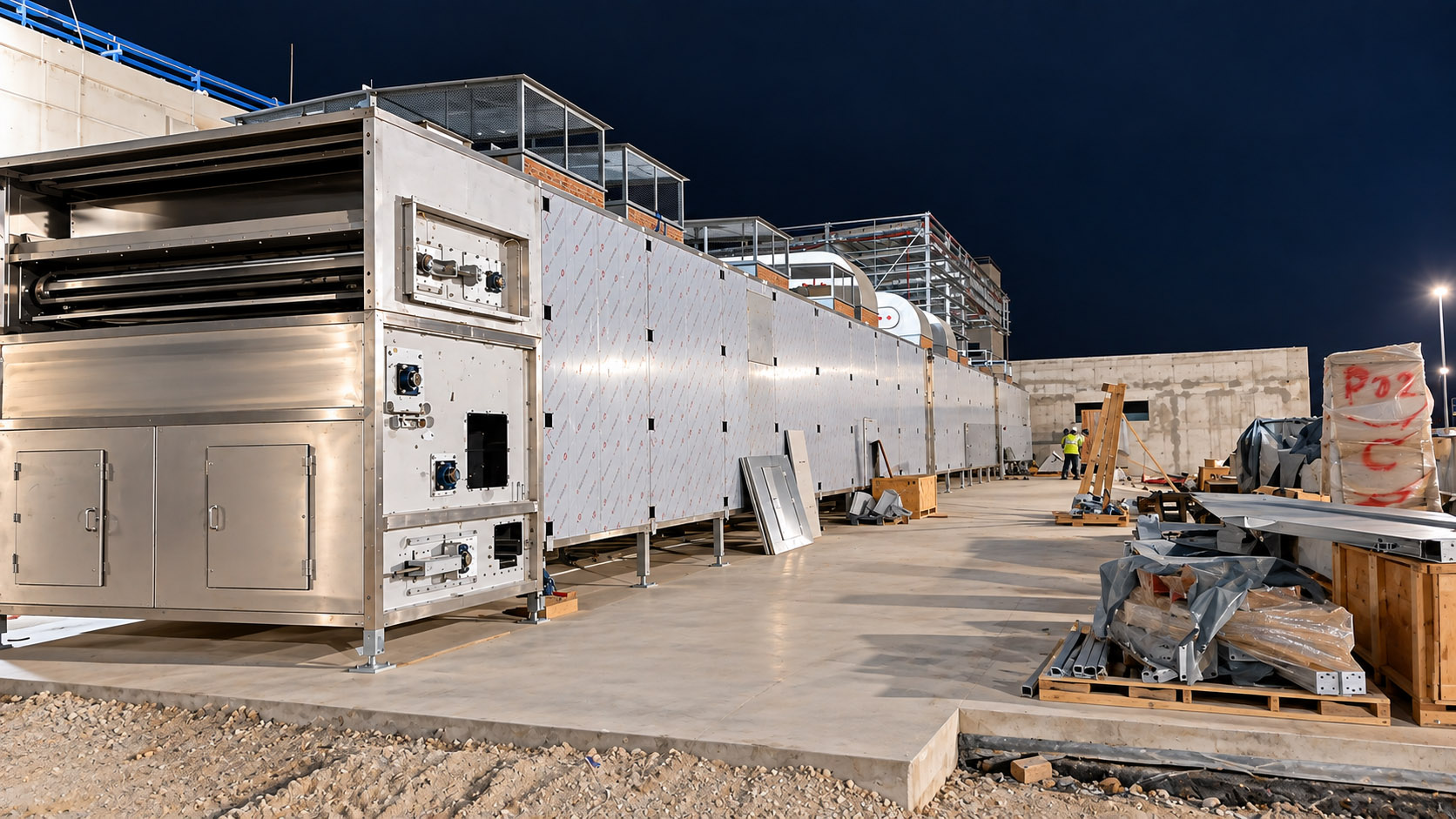
Installation of a belt drying system for digestate in Daya, Israel

Frequently asked questions about digestate drying
With very high moisture content, feeding the material directly onto the drying belt can be problematic. Therefore, in the IL-Daya project, already dried final product is mixed back into the wet press water.
This creates a consistency that can then be distributed evenly onto the drying belt.
The press-water fraction enters the system with a solids content of around 20%. After preparation and drying, however, the material leaves the system with a dry matter content of around 80%.
The system achieves a water evaporation capacity of around 2.8 tonnes per hour. In addition, the belt dryer has a belt area of approx. 114 m² and an overall length of almost 50 meters.
Heating is provided by hot-water heat exchangers. In addition, the system features integrated heat recovery.
Without further treatment, the wet feed material is neither suitable for storage nor for transport. Drying, however, produces a stable product with a dry matter content of around 80%.
As a result, it can be stored, transported and subsequently sent for further utilization.
Without further treatment, the wet feed material is neither suitable for storage nor for transport. Drying, however, produces a stable product with a dry matter content of around 80%.
As a result, it can be stored, transported and subsequently sent for further utilization.


Frequently Asked Questions About the R&D Tax Incentive in Mechanical Engineering
The R&D Tax Incentive is a tax-based funding program provided by the German federal government to support companies carrying out research and development projects. Its purpose is to promote innovation in Germany and help businesses develop new technologies, products, and processes in an economically viable way. Instead of a traditional grant, the funding is provided through tax relief, which can significantly reduce the actual costs of development.
In principle, companies of any size and from almost any industry can apply for the R&D Tax Incentive—from small family-owned businesses to internationally operating industrial companies. The decisive factor is not the size of the company, but whether the development project meets the legal eligibility requirements.
Yes. Mechanical and plant engineering companies frequently develop customized solutions, prototypes, and innovative processes that may qualify for funding. The practical example of Hans Binder Engineering GmbH demonstrates how the R&D Tax Incentive can help medium-sized companies implement innovative technologies in an economically viable way.
Depending on the project, eligible costs may include personnel expenses, in-house development work, contract research, and other costs defined by law. Which expenses are actually eligible depends on the applicable legal regulations.
Yes. The development and testing of prototypes are among the typical research and development activities that can be taken into account under the R&D Tax Incentive, provided the legal eligibility requirements are met.
Ideally, planning should begin as soon as the development project starts. Early documentation of all relevant activities significantly simplifies the application process and helps ensure that all important information can later be fully documented and verified.